Strength training for women over 60: a simple weekly plan
Strength training for women over 60 means working all your major muscles, legs, hips, back, abdomen, chest, shoulders and arms, on at least 2 days a week, as the CDC and WHO recommend. Start with body weight and a light band: 1 set of 8 to 12 slow repetitions per move.
The plan below follows those guidelines with seven moves you can do at home with a chair, a light resistance band and a mat, each with a seated or standing option. It is general information, not a medical program. Rose, who shows the moves, is an AI-generated character.
Written with AI tools from the sources listed at the end of this article, and not reviewed by a doctor or physical therapist. Who makes Fit with Rose.
How much strength training do women over 60 need?
At least 2 days a week, working every major muscle group. The CDC recommends at least 2 days of muscle-strengthening activities for adults 65 and older, working the legs, hips, back, abdomen, chest, shoulders and arms (CDC). The WHO 2020 guidelines give all adults the same rule, 2 or more days a week at moderate or greater intensity, and add balance and strength activity on 3 or more days a week for older adults (WHO 2020 guidelines). These recommendations are the same for women and men.
| CDC (65 and older) | WHO 2020 | National Institute on Aging | |
|---|---|---|---|
| Muscle strengthening | At least 2 days, all major muscle groups | 2 or more days, moderate or greater intensity, all major muscle groups | At least 2 days; not the same muscle group two days in a row |
| Balance | Balance activities, such as walking heel-to-toe or standing from a sitting position | Older adults: activity that emphasizes functional balance and strength, 3 or more days | About three sessions a week |
| Aerobic activity | At least 150 minutes at moderate intensity | 150–300 minutes at moderate intensity, or 75–150 minutes at vigorous intensity | Build up to at least 150 minutes at moderate intensity, such as brisk walking |
Sources: CDC, WHO 2020 guidelines, National Institute on Aging. If you cannot reach these amounts, the CDC says to be as physically active as your abilities and conditions allow.
Is strength training safe after 60, and does it work?
Studies of older adults are reassuring, as long as you start light and build up slowly:
- A Cochrane review of 121 trials with 6,700 older participants found that progressive resistance training had a large positive effect on muscle strength, and a moderate to large effect on getting out of a chair. In most trials, people trained two to three times a week (Cochrane review, 2009).
- The same review reports that musculoskeletal complaints, such as joint pain and muscle soreness, came up in many of the studies that tracked them, while serious adverse events were rare (Cochrane review, 2009).
- A 2025 analysis of 102 trials with 4,754 older adults found moderate to large strength gains with every type of training it compared, including body-weight and elastic band training, not only machines and free weights (Wiedenmann et al., 2025).
These are average results from studies, not a promise for any one person.
How hard should strength exercises feel?
Hard by the last repetition, but never painful. The National Institute on Aging describes the right effort as at least moderate, done to the point where it would be difficult to do another repetition, and suggests that beginners learn each movement without weights or bands first (NIA).
What does a weekly strength plan for women over 60 look like?
Two strength days with at least one day between them, plus balance and walking on the other days. Here is a sample week, which you can shift to suit your own:
| Day | Plan |
|---|---|
| Monday | Strength: the 7 moves below |
| Tuesday | A walk, then the balance exercises |
| Wednesday | Rest, or an easy walk |
| Thursday | Strength: the 7 moves below |
| Friday | A walk, then the balance exercises |
| Saturday | Balance exercises, or an activity you enjoy |
| Sunday | Rest |
7 strength exercises for women over 60
Together they work the legs, hips, back, abdomen, chest, shoulders and arms. You need a sturdy chair without wheels or armrests, placed against a wall, a long resistance band and a mat.
1Sit-to-Stand
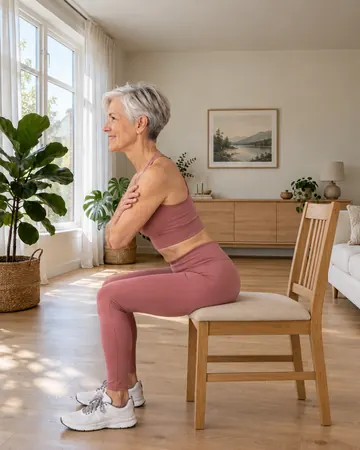
1. Start 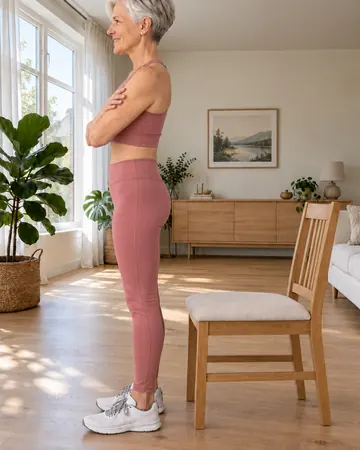
2. Stand up Works: legs and glutes
- Sit on the front edge of the chair, feet flat and hip-width apart, arms crossed over your chest.
- Lean forward from your hips and push through your heels to stand tall.
- Take three seconds to sit back down, with control.
Easier: Use your hands on your thighs to help you up.
Harder: Pause for one second just above the seat before you sit.
Sets and reps: 1 set of 8–10 at first, then 2 sets. Rest 30–60 seconds.
Safety: Keep your knees in line with your toes as you stand.
2Seated Knee Extension
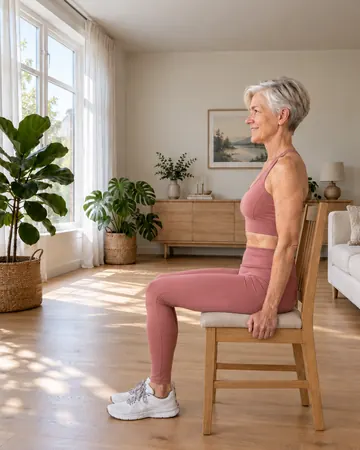
1. Start 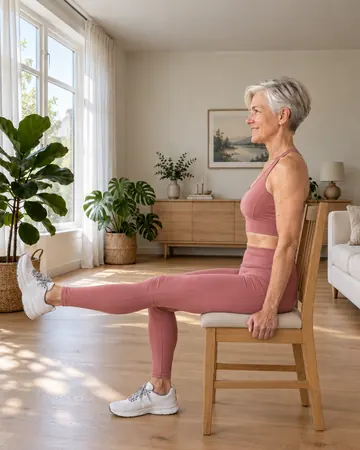
2. Straighten one leg Works: front of the thighs
- Sit tall and hold the sides of the seat.
- Straighten one knee until your leg is level with the floor.
- Hold for two seconds, then lower slowly.
Seated: Always done seated.
Harder: Put a loop band around your ankles.
Sets and reps: 1 set of 10 per leg at first, then 2 sets. Rest 30–60 seconds.
Safety: Straighten the leg smoothly, without snapping the knee.
3Wall Push-Up
Works: chest, shoulders and arms
- Stand facing a wall, a little more than arm's length away, feet hip-width apart.
- Place your hands flat on the wall at shoulder height, shoulder-width apart.
- Bend your elbows to bring your chest toward the wall, keeping your body straight, then push back slowly.
Standing: Stand a little further from the wall to make it harder, closer to make it easier.
Seated: Do the chest press with a band from our resistance band exercises.
Sets and reps: 1 set of 8–12 at first, then 2 sets. Rest 30–60 seconds.
Safety: Wear shoes or stand on a non-slip floor so your feet cannot slide.
4Seated Band Row
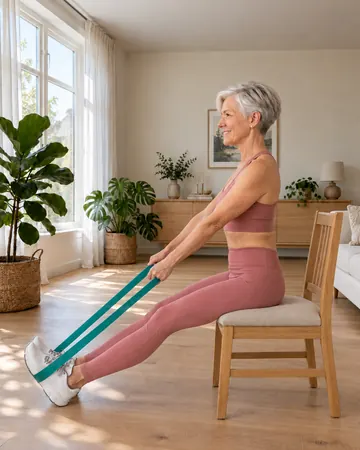
1. Start 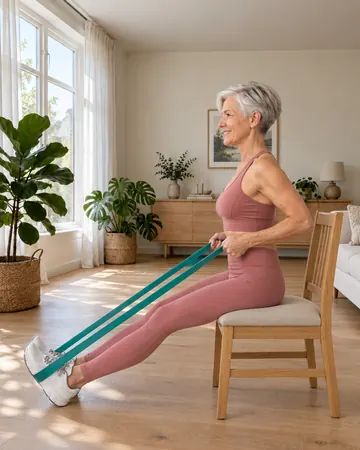
2. Pull Works: upper back and posture
- Sit tall with your legs out and a long band around your feet.
- Pull your elbows back past your ribs and squeeze your shoulder blades.
- Return slowly, keeping your chest lifted.
Seated: Always done seated; bend your knees a little if straight legs are uncomfortable.
Sets and reps: 1 set of 10–12 at first, then 2 sets. Rest 30–60 seconds.
Safety: Do not round your back on the way back.
5Standing Biceps Curl
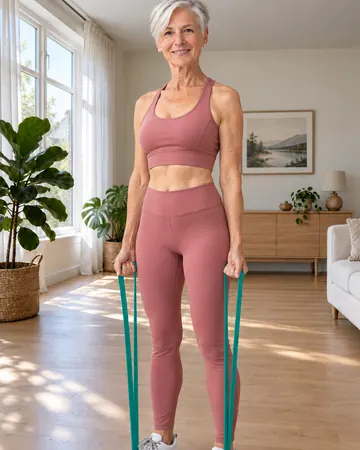
1. Start 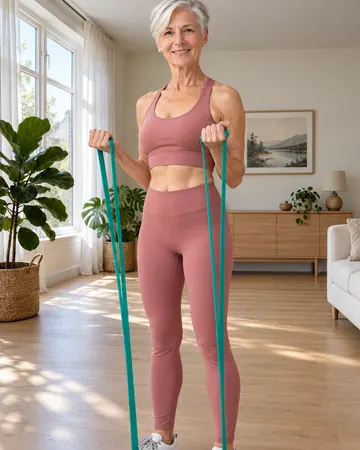
2. Curl up Works: arms
- Stand on the middle of the band, feet hip-width apart.
- Keep your elbows at your sides and curl your hands up.
- Lower slowly.
Standing: On a non-slip floor or on your mat.
Seated: Sit tall with the band under both feet.
Sets and reps: 1 set of 10–12 at first, then 2 sets. Rest 30–60 seconds.
Safety: Elbows stay at your sides; do not swing your back.
6Glute Bridge
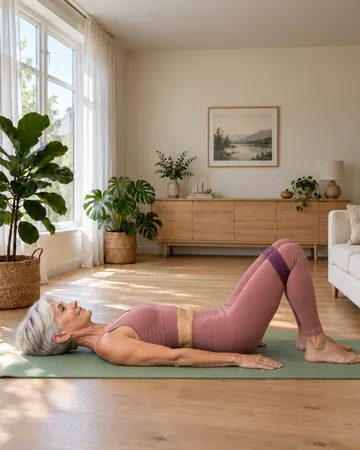
1. Start 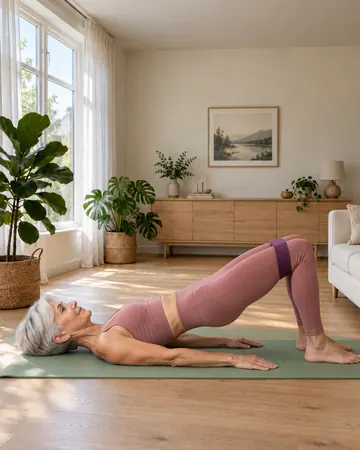
2. Lift Works: glutes and lower back
- Lie on your back on a mat, knees bent, feet flat, arms by your sides.
- Squeeze your glutes and lift your hips until your shoulders, hips and knees line up.
- Lower slowly, one vertebra at a time.
No floor work: Do a second round of sit-to-stands instead.
Harder: Add a loop band just above your knees, as in the pictures.
Sets and reps: 1 set of 10 at first, then 2 sets. Rest 30–60 seconds.
Safety: Lift only as high as feels comfortable for your lower back.
7Bird Dog
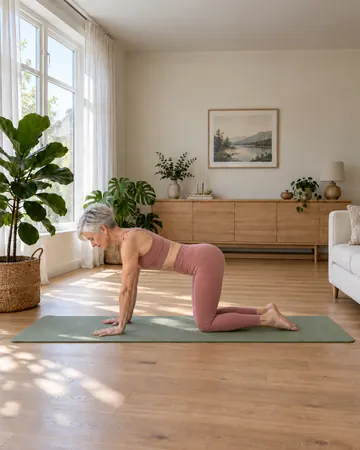
1. Start 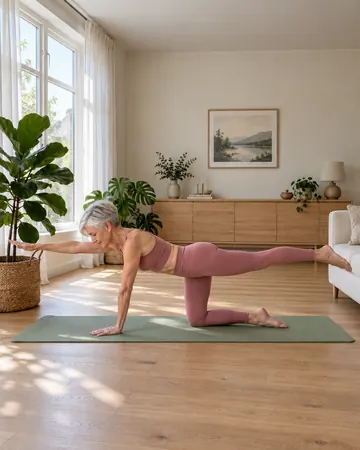
2. Reach Works: back, abdomen and balance
- Get on all fours on your mat: hands under shoulders, knees under hips.
- Reach one arm forward and the opposite leg back.
- Hold for a breath, come back, then switch sides.
Easier: Lift only the arm, or only the leg.
Seated: Sit tall at the front of the chair, raise one arm forward and lift the opposite foot a little, hold, then switch.
Sets and reps: 8 on each side.
Safety: Keep your back flat like a table. Skip the floor version if kneeling hurts your knees.
Pictures: AI-generated images of Rose, the Fit with Rose character. All the moves of our kit, ready to print, are on the printable chair exercises page.
How do you progress without overdoing it?
One small change at a time. The National Institute on Aging says gradual increases in weight, sets, repetitions or days a week make muscles stronger, and warns that overdoing it can cause exhaustion, sore joints, and muscle pain or injury (NIA). A simple path:
| Weeks | What to do |
|---|---|
| 1 and 2 | 1 set of each move, at the bottom of the repetition range, with the easier versions |
| 3 and 4 | 1 set, up to the top of the range |
| 5 and 6 | 2 sets of each move |
| Then | 3 sets, a stronger band or the harder versions, one change at a time |
If a session leaves you sore or tired for days, go back one step. For more band moves, see our resistance band exercises for seniors; for the balance days, our balance exercises for seniors.
Watch the moves
Short videos of some of these moves, with Rose. The player loads from YouTube only when you press play.
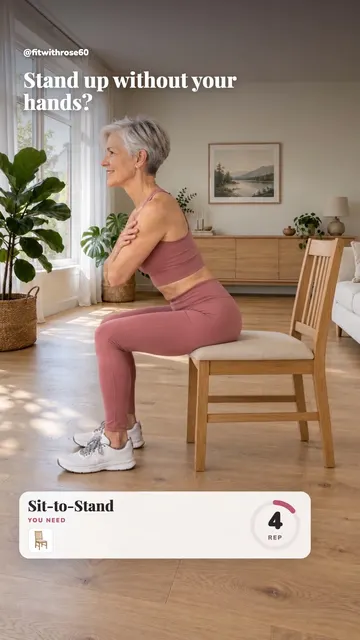
Sit-to-Stand (short video)
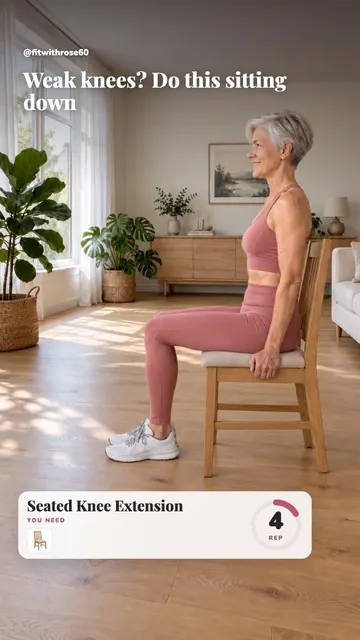
Seated Knee Extension (short video)
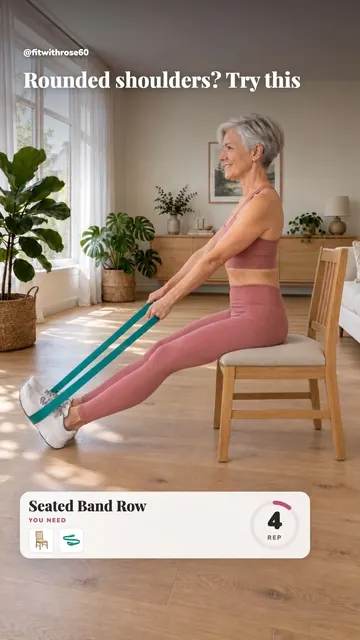
Seated Band Row (short video)
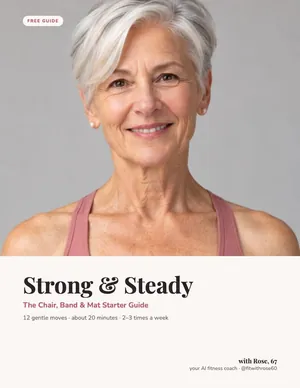
Get the free PDF guide
Strong & Steady: The Chair, Band & Mat Starter Guide. 9 pages to print or keep on your phone:
- 12 moves with pictures and simple steps;
- two sessions of about 20 minutes;
- a weekly plan with boxes to tick, and a plan for your first four weeks.
Questions
How often should a woman over 60 do strength training?
At least 2 days a week, working all major muscle groups, according to the CDC (for adults 65 and older) and the WHO 2020 guidelines. The National Institute on Aging advises against working the same muscle group on two days in a row.
Is it too late to start strength training at 60 or 70?
Studies of older adults suggest it is not: a Cochrane review of 121 trials found that progressive resistance training had a large positive effect on muscle strength in older people. Start light, build up slowly and check with your doctor first.
Can I build strength without weights?
Yes. The National Institute on Aging lists body-weight exercises such as squats and push-ups, and resistance bands, among muscle-strengthening activities. A 2025 analysis of 102 trials found strength gains in older adults with body-weight and with elastic band training.
How many sets and reps should I do?
The National Institute on Aging says one set of 8 to 12 repetitions of each exercise is effective, and that two or three sets may be more effective. Each set should end close to the point where another repetition would be difficult.
Is strength training safe if I have osteoporosis?
Ask your doctor or a physical therapist first: they can tell you which moves suit you and which to avoid. This article is general information and cannot make that call for you.
Keep going
Resistance band exercises for seniors: 7 gentle moves
Seven band moves with pictures, seated and standing options, sets and reps, and what the research says about training with bands.
Balance exercises for seniors: seated and standing options
Five supported balance moves, each with a seated or easier version and a standing one, plus how often to practice and how to progress safely.
Chair exercises for seniors: free printable guide
9 chair exercises with pictures, steps and reps to print, plus the free PDF guide with a weekly plan.
Sources
Health facts in this article come from these sources, checked on 25 October 2026. Studies were read on PubMed. The moves, steps and repetitions come from the Fit with Rose guide.
- CDC, Older Adult Activity: An Overview, page dated 4 December 2025.
- Bull FC, et al. (World Health Organization), British Journal of Sports Medicine, World Health Organization 2020 guidelines on physical activity and sedentary behaviour, 2020.
- National Institute on Aging (NIH), Three Types of Exercise Can Improve Your Health and Physical Ability, content reviewed 14 January 2025.
- Liu CJ, Latham NK, Cochrane Database of Systematic Reviews, Progressive resistance strength training for improving physical function in older adults, 2009.
- Wiedenmann T, et al., Gerontology, The Effects of Different Resistance Training Modalities on Muscle Strength in Community-Dwelling Older Adults: A Network Meta-Analysis, 2025.
- NHS, Physical activity guidelines for older adults, page last reviewed 15 August 2024.
Rose is an AI-generated character, not a real person, and not a doctor, physical therapist or certified trainer. This article shares general fitness information, not medical advice.