Resistance band exercises for seniors: 7 gentle moves
Resistance band exercises for seniors can be simple moves done in a sturdy chair, holding its back or on a mat: the seated row, chest press, pull-apart, biceps curl, knee opening, side steps and glute bridge. Do 1 to 3 sets of 8 to 12 slow repetitions on 2 days a week, starting with a light band.
The sets, repetitions and weekly days follow the advice of the National Institute on Aging and the CDC. The moves come from our free guide. Each one below has two pictures, three steps, a seated or standing option and a safety cue. Rose, who shows the moves, is an AI-generated character.
Written with AI tools from the sources listed at the end of this article, and not reviewed by a doctor or physical therapist. Who makes Fit with Rose.
Are resistance bands good for seniors?
Yes, they are a recognized way to train your muscles: the National Institute on Aging lists resistance bands among muscle-strengthening activities for older adults, next to weight machines and hand-held weights (NIA). Studies of older adults point the same way, with some caution:
- A 2025 network meta-analysis of 102 trials with 4,754 older adults living in the community (mean age 70) found that every type of resistance training it compared, elastic bands included, had moderate to large positive effects on strength compared with no training. Machines had the largest effect; the authors suggest the choice can depend on preference, enjoyment and practicality (Wiedenmann et al., 2025).
- A 2025 meta-analysis of 25 studies with 1,318 participants concluded that elastic band training may improve lower-limb strength and balance in older adults, and that more high-quality studies are needed (Meng et al., 2025).
- A 2024 meta-analysis of 9 trials with 477 healthy older people found improvements in the 30-second chair stand, sit-and-reach and timed up-and-go tests, but rated the certainty of the evidence as very low (Hernandez-Martinez et al., 2024).
In short: bands are a practical way to train at home, and the research is encouraging but not final. These are average results from studies, not a promise for any one person.
Which resistance band should you start with?
A light one. The National Institute on Aging describes resistance bands as stretchy elastic bands that come in varying strengths, and suggests that beginners first try the movements without weights or bands until they are comfortable (NIA). The routine below uses two kinds of band:
| Band | What it looks like | Used for | Start with |
|---|---|---|---|
| Long band | A long flat strip or tube that you hold at both ends | Seated row, chest press, pull-apart, biceps curl | Light or medium resistance |
| Loop band | A small closed loop, often made of fabric, worn just above the knees | Knee opening, side steps, glute bridge | A light fabric mini band |
Read the resistance level on the package rather than going by color, and keep the lightest band for your first weeks.
How many sets and reps should seniors do with resistance bands?
Start with 1 set of 8 to 12 repetitions of each move. The National Institute on Aging says one set of eight to 12 repetitions of each exercise is effective, and that two or three sets may be more effective (NIA). Train at least 2 days a week, working all your major muscle groups (CDC), but not the same muscle group on two days in a row (NIA).
- Effort: by the last repetition, another one should feel difficult. That is how the NIA describes the right effort for strength exercises.
- Speed: about two seconds to pull or push, two seconds to return.
- Rest: 30 to 60 seconds between sets.
- Breathing: breathe out during the effort and in as you relax; do not hold your breath (NIA).
7 resistance band exercises for seniors, step by step
Do them in this order: upper body first, then hips. The first five can be done seated. Use a sturdy chair without wheels or armrests, against a wall.
1Seated Band Row
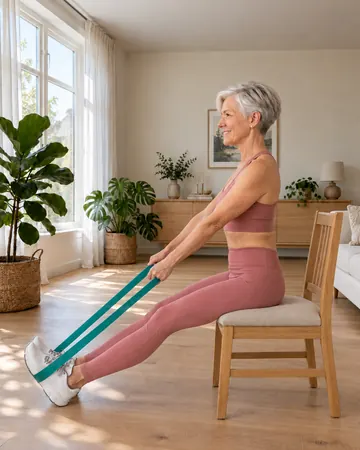
1. Start 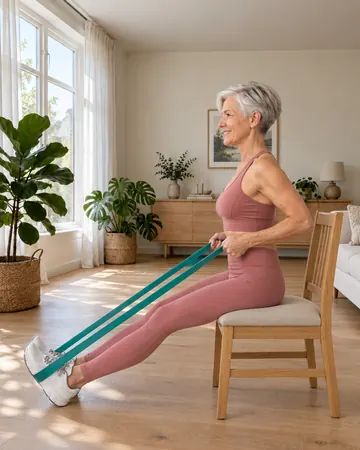
2. Pull Works: upper back and posture
- Sit tall near the front of the chair, legs out in front, with the middle of a long band looped around the soles of your feet.
- Hold one end in each hand, then pull your elbows back past your ribs and squeeze your shoulder blades together.
- Return slowly until your arms are long again, keeping your chest lifted.
Seated: This one is always done seated. If straight legs feel uncomfortable, bend your knees a little.
Sets and reps: 1 set of 10–12 at first, then 2 sets. Rest 30–60 seconds.
Safety: Keep your back straight; do not round forward as you return.
2Chest Press
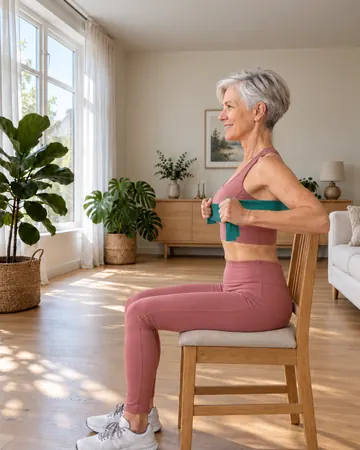
1. Start 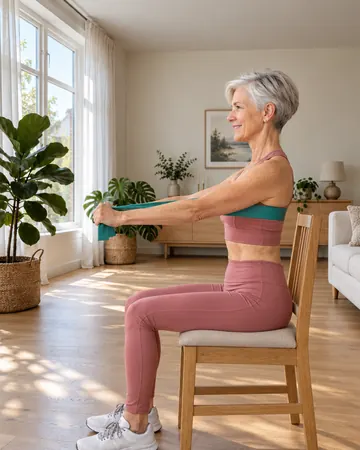
2. Push Works: chest and arms
- Pass the band behind your upper back and under your arms, one end in each hand.
- Push both hands forward at chest height until your arms are almost straight.
- Bring your hands back slowly to your chest.
Seated: Sit tall at the front of the chair, feet flat on the floor.
Standing: Stand with your feet hip-width apart and your knees soft, and do the same move.
Sets and reps: 1 set of 10 at first, then 2 sets. Rest 30–60 seconds.
Safety: Breathe out as you push, and stop just before your elbows lock: the NIA advises against locking your arm and leg joints (NIA).
3Band Pull-Apart
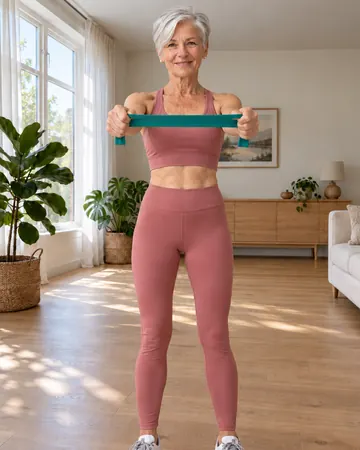
1. Start 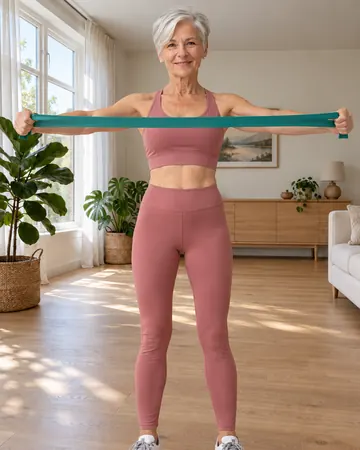
2. Pull apart Works: shoulders and posture
- Hold a long band with both hands, shoulder-width apart, arms straight in front of you at chest height.
- Pull the band apart, moving your hands out to the sides.
- Return with control.
Standing: Stand tall, feet hip-width apart.
Seated: Sit tall at the front of the chair and do the same move.
Sets and reps: 1 set of 12 at first, then 2 sets. Rest 30–60 seconds.
Safety: Keep your shoulders down, away from your ears. Stop if your shoulder hurts.
4Biceps Curl
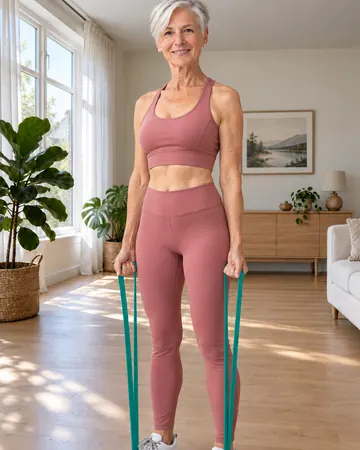
1. Start 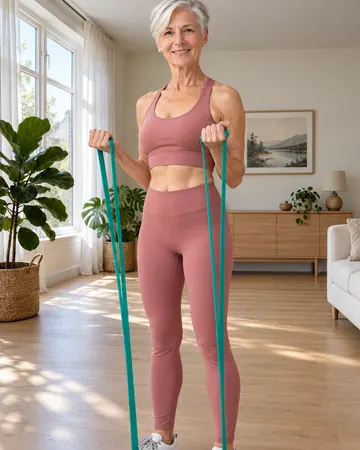
2. Curl up Works: arms
- Stand on the middle of a long band, feet hip-width apart, one end in each hand.
- Keep your elbows at your sides and curl your hands up toward your shoulders.
- Lower slowly.
Standing: Stand on a non-slip floor or on your mat.
Seated: Sit tall with the band under both feet and curl the same way.
Sets and reps: 1 set of 10–12 at first, then 2 sets. Rest 30–60 seconds.
Safety: Check that the band is secure under your feet before you pull, so it cannot slip out.
5Seated Knee Opening
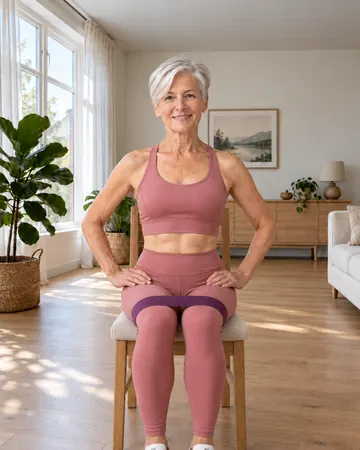
1. Start 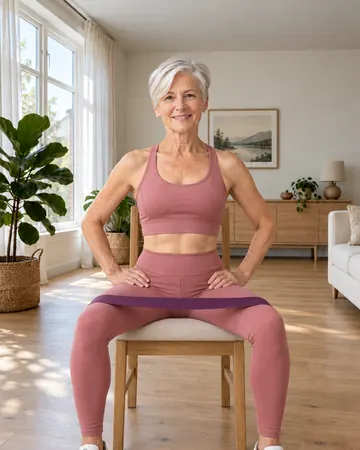
2. Knees out Works: outer hips
- Sit tall with a loop band just above your knees, feet flat.
- Push your knees out against the band.
- Hold for two seconds, then return slowly.
Seated: A seated move. Its standing version is the side steps, next.
Sets and reps: 1 set of 12–15 at first, then 2 sets. Rest 30–60 seconds.
Safety: Keep your feet still; only the knees move.
6Supported Side Steps
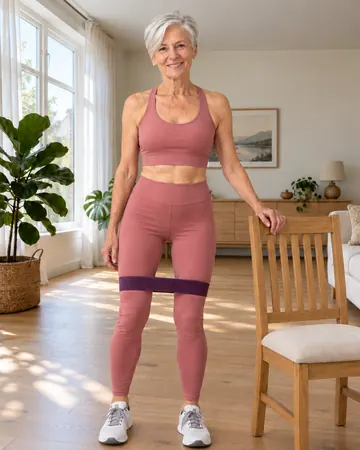
1. Start 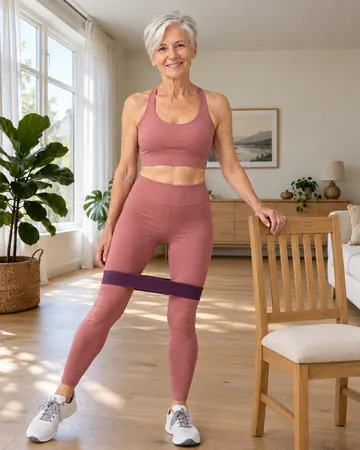
2. Step out Works: hips and balance
- Stand beside a sturdy chair or a kitchen counter, one hand on it, with the loop band just above your knees and your knees soft.
- Take a small step out to the side, then bring the other foot in.
- After 8 steps, go back the other way.
Standing: Keep one hand on the chair or counter the whole time.
Seated: Not ready to stand with a band? Do the seated knee opening instead.
Sets and reps: 1 set of 8 steps each way at first, then 2 sets. Rest 30–60 seconds.
Safety: Small steps and a tall posture. Start without the band if the move feels unsteady.
7Glute Bridge

1. Start 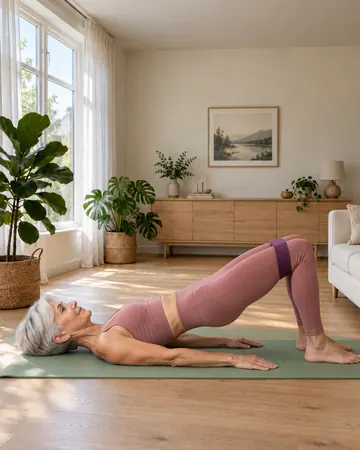
2. Lift Works: glutes and lower back
- Lie on your back on a mat, knees bent, feet flat, with the loop band just above your knees.
- Press your knees gently out against the band and lift your hips until your shoulders, hips and knees line up.
- Lower slowly, one vertebra at a time.
No floor work: If getting down to the floor is hard, do the sit-to-stand from our printable chair exercises instead.
Sets and reps: 1 set of 10 at first, then 2 sets. Rest 30–60 seconds.
Safety: Lift only as high as feels comfortable for your lower back.
Pictures: AI-generated images of Rose, the Fit with Rose character. All the moves of our kit, ready to print, are on the printable chair exercises page.
What does a full resistance band routine look like?
All seven moves in order, 2 days a week with at least one day off in between, for example Monday and Thursday. Warm up first with a minute or two of marching in your chair, then an easy first set: the NIA suggests warming up for strength work with less weight (NIA).
| Move | Band | Position | Sets × reps | Rest |
|---|---|---|---|---|
| 1. Seated Band Row | Long | Seated | 1–2 × 10–12 | 30–60 s |
| 2. Chest Press | Long | Seated or standing | 1–2 × 10 | 30–60 s |
| 3. Band Pull-Apart | Long | Standing or seated | 1–2 × 12 | 30–60 s |
| 4. Biceps Curl | Long | Standing or seated | 1–2 × 10–12 | 30–60 s |
| 5. Seated Knee Opening | Loop | Seated | 1–2 × 12–15 | 30–60 s |
| 6. Supported Side Steps | Loop | Standing, holding on | 1–2 × 8 steps each way | 30–60 s |
| 7. Glute Bridge | Loop | On a mat | 1–2 × 10 | 30–60 s |
How do you make band exercises harder or easier?
Change one thing at a time, every week or two. The National Institute on Aging says gradual increases in the amount of weight, the number of sets or repetitions, or the number of days a week make muscles stronger (NIA). With a band, that means:
- Add repetitions, up to the top of the range.
- Add a second set, then a third.
- Hold the band a little shorter, so it stretches more.
- Move up to the next band strength.
To make a move easier, do the reverse: hold the band longer, use a lighter band, or do the move without a band.
Watch the moves
Short videos of some of these moves, with Rose. The player loads from YouTube only when you press play.
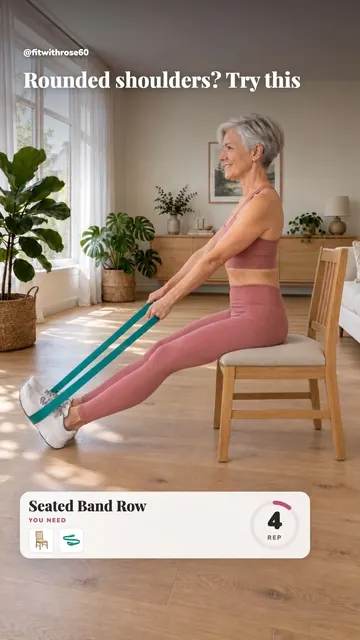
Seated Band Row (short video)
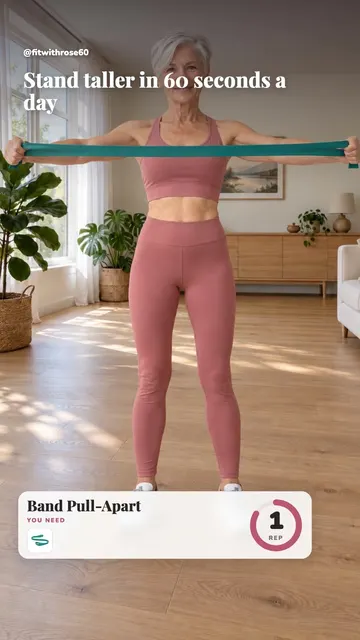
Band Pull-Apart (short video)
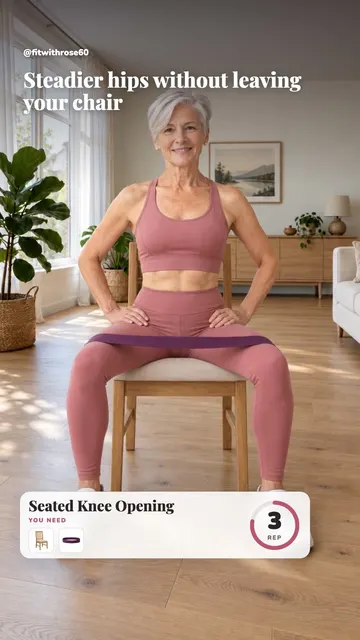
Seated Knee Opening (short video)

Get the free PDF guide
Strong & Steady: The Chair, Band & Mat Starter Guide. 9 pages to print or keep on your phone:
- 12 moves with pictures and simple steps;
- two sessions of about 20 minutes;
- a weekly plan with boxes to tick, and a plan for your first four weeks.
Questions
Are resistance bands good for seniors?
The National Institute on Aging lists resistance bands among muscle-strengthening activities for older adults. A 2025 analysis of 102 trials found that elastic band training had moderate to large positive effects on strength in older adults compared with no training, although machines had a larger effect. Check with your doctor before you start.
How often should seniors do resistance band exercises?
The CDC recommends muscle-strengthening activities on at least 2 days a week for adults 65 and older, working all major muscle groups. The National Institute on Aging adds that you should not work the same muscle group on two days in a row.
How many reps should a senior do with a resistance band?
The National Institute on Aging says one set of 8 to 12 repetitions of each exercise is effective, and that two or three sets may be more effective. In our routine, rest 30 to 60 seconds between sets.
Which resistance band is best for beginners?
Start with a light long band for the arm and back moves and a light fabric loop band for the hip moves. Read the resistance level on the package rather than going by color, and move up only when 2 sets feel easy.
Can I do resistance band exercises sitting down?
Yes. In this routine, the seated row, chest press, pull-apart, biceps curl and knee opening can all be done sitting tall in a sturdy chair without wheels or armrests.
Keep going
Strength training for women over 60: a simple weekly plan
How much strength training the CDC and WHO recommend, a sample week, and seven home moves for every major muscle group, with seated or standing options.
Balance exercises for seniors: seated and standing options
Five supported balance moves, each with a seated or easier version and a standing one, plus how often to practice and how to progress safely.
Chair exercises for seniors: free printable guide
9 chair exercises with pictures, steps and reps to print, plus the free PDF guide with a weekly plan.
Sources
Health facts in this article come from these sources, checked on 25 October 2026. Studies were read on PubMed. The moves, steps and repetitions come from the Fit with Rose guide.
- National Institute on Aging (NIH), Three Types of Exercise Can Improve Your Health and Physical Ability, content reviewed 14 January 2025.
- CDC, Older Adult Activity: An Overview, page dated 4 December 2025.
- NHS, Physical activity guidelines for older adults, page last reviewed 15 August 2024.
- Wiedenmann T, et al., Gerontology, The Effects of Different Resistance Training Modalities on Muscle Strength in Community-Dwelling Older Adults: A Network Meta-Analysis, 2025.
- Meng Y, et al., Frontiers in Sports and Active Living, Effects of elastic band resistance training on lower limb strength and balance function in older adults: a systematic review and meta-analysis, 2025.
- Hernandez-Martinez J, et al., Experimental Gerontology, Effects of elastic band training on body composition and physical performance in older people: A systematic review with meta-analysis, 2024.
Rose is an AI-generated character, not a real person, and not a doctor, physical therapist or certified trainer. This article shares general fitness information, not medical advice.