Balance exercises for seniors: seated and standing options
Balance exercises for seniors are slow, supported moves that train you to stay steady on your feet: standing up from a chair, heel raises, standing on one foot, side steps and the heel-to-toe walk. Keep a sturdy chair within reach every time. The National Institute on Aging suggests about three sessions of balance exercises a week.
The CDC names walking heel-to-toe and standing from a sitting position as examples of balance activities for adults 65 and older. Each move below starts with a seated or fully supported version, then a standing one. Rose, who shows the moves, is an AI-generated character.
Written with AI tools from the sources listed at the end of this article, and not reviewed by a doctor or physical therapist. Who makes Fit with Rose.
Why does balance matter after 60?
Because falls are common. The CDC says that more than one out of four older people falls each year, but less than half tell their doctor, and that falling once doubles your chances of falling again (CDC, 2026).
Research on exercise is encouraging:
- A 2019 Cochrane review of 108 randomized trials with 23,407 people living in the community (average age 76; 77% were women) found that exercise reduces the rate of falls by 23%, with high-certainty evidence. Balance and functional exercises reduced the rate of falls by 24% (Cochrane review, 2019).
- The WHO 2020 guidelines recommend that older adults do varied physical activity that emphasizes functional balance and strength training, at moderate or greater intensity, on 3 or more days a week, with the aims of improving functional capacity and preventing falls (WHO 2020 guidelines).
These are average results from studies of groups of people, not a promise for you. If you have fallen, tell your doctor, even if you were not hurt.
How often should seniors do balance exercises?
About three times a week. The National Institute on Aging suggests about three sessions of balance exercises a week (NIA), and the WHO recommends balance and strength activity on 3 or more days a week for older adults (WHO 2020 guidelines). You can do the routine below on its own or right after a strength session.
| Source | Recommendation | Examples they give |
|---|---|---|
| CDC (adults 65 and older) | Balance activities as part of weekly activity | Walking heel-to-toe, standing from a sitting position |
| National Institute on Aging | About three sessions of balance exercises a week | Standing on one foot, the heel-to-toe walk, walking backward or sideways, standing from a sitting position, tai chi, yoga |
| WHO 2020 (older adults) | Varied activity that emphasizes functional balance and strength training, moderate or greater intensity, 3 or more days a week | Combinations of balance, strength, endurance, gait and physical function training |
5 balance exercises for seniors, from seated to standing
Do them in this order, beside a sturdy chair without wheels, placed against a wall, or along a kitchen counter. Start with the easier version of each move and keep it for a week or two before you try the next one.
1Sit-to-Stand
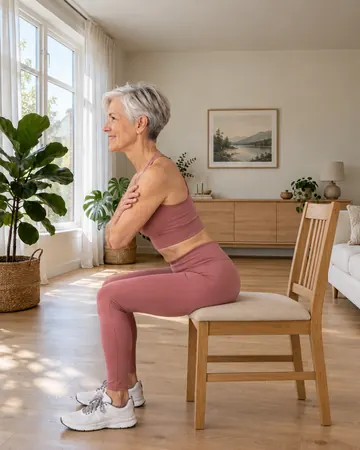
1. Start 
2. Stand up Works: legs, glutes and standing up steadily
- Sit on the front edge of a sturdy chair placed against a wall, feet flat and hip-width apart.
- Lean forward from your hips and push through your heels to stand up tall.
- Pause for a breath, then lower yourself slowly back onto the seat.
Easier: Put your hands on your thighs to help you up.
Harder: Cross your arms over your chest and take three seconds to sit down.
Sets and reps: 1 set of 8–10 at first, then 2 sets. Rest 30–60 seconds.
Safety: The chair stays against the wall so it cannot slide.
2Heel Raises
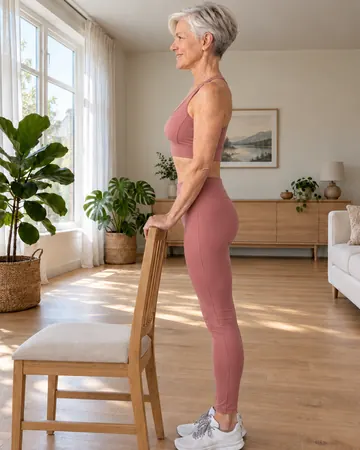
1. Start 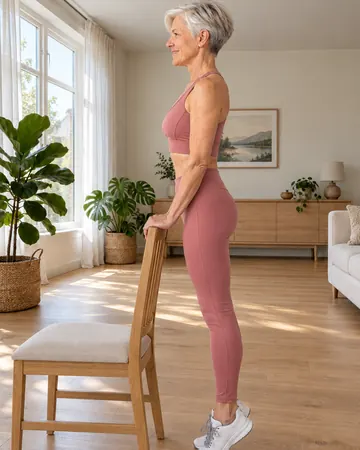
2. Rise up Works: calves and ankles
- Stand behind the chair with both hands resting lightly on the backrest.
- Rise slowly onto the balls of your feet.
- Hold for one second, then lower your heels slowly.
Seated: Sit tall with your feet flat, lift both heels off the floor, then lower them.
Standing: As you get steadier, rest one hand, then only your fingertips, on the backrest.
Sets and reps: 1 set of 10–15 at first, then 2 sets. Rest 30–60 seconds.
Safety: The chair is there for balance, not to lean on: stay tall.
3Standing on One Foot

1. Start 
2. Lift one knee Works: ankles, hips and balance
- Stand beside your chair, one hand on the backrest.
- Lift one knee and hold for up to 20 seconds.
- Lower the foot and switch legs.
Seated: Sit tall and lift one knee a few inches, hold for a few seconds, then switch, like a slow seated march.
Standing: Hold a little longer each week, up to 20 seconds, and hold the chair with your fingertips instead of your whole hand.
Sets and reps: 2 or 3 holds on each leg.
Safety: Keep a hand on the chair back the whole time.
4Side Steps
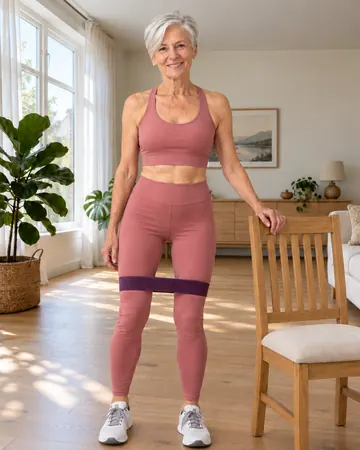
1. Start 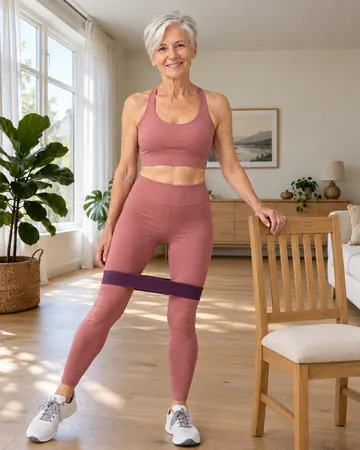
2. Step out Works: hips and balance
- Stand beside a sturdy chair or along a kitchen counter, one hand on it, knees soft.
- Take a small step to the side, then bring the other foot in.
- After 8 steps, go back the other way.
Seated: Do the seated knee opening from our resistance band exercises.
Harder: Add a light loop band just above your knees, as in the pictures.
Sets and reps: 1 set of 8 steps each way at first, then 2 sets.
Safety: Small steps, tall posture, and never cross your feet.
5Heel-to-Toe Walk
Works: balance while walking
- Stand at one end of a kitchen counter with one hand resting on it, and look ahead rather than at your feet.
- Place one heel just in front of the toes of the other foot, as if walking along a line.
- Take 10 slow steps this way, then turn around carefully and walk back.
Easier: Stand still with one foot just in front of the other, holding the counter, for up to 20 seconds, then switch feet.
Harder: Let your heel touch your toes on each step.
Sets and reps: 2 lengths of 10 steps.
Safety: Always along a counter or a wall, never in the middle of the room.
Pictures: AI-generated images of Rose, the Fit with Rose character. All the moves of our kit, ready to print, are on the printable chair exercises page.
What does a balance routine for seniors look like?
The five moves in order, about three times a week. Here is the whole routine on one screen:
| Move | Easier or seated version | Standing version | Amount |
|---|---|---|---|
| 1. Sit-to-Stand | Hands on your thighs | Arms crossed, slow way down | 1–2 × 8–10 |
| 2. Heel Raises | Seated heel lifts | Fingertips on the chair | 1–2 × 10–15 |
| 3. Standing on One Foot | Seated knee lifts | Up to 20 seconds per leg | 2–3 holds per leg |
| 4. Side Steps | Seated knee opening | With a loop band | 1–2 × 8 steps each way |
| 5. Heel-to-Toe Walk | Standing still, one foot in front | Heel touching toes | 2 lengths of 10 steps |
How do you make balance exercises harder, safely?
Slowly, and without giving up the support. Our rule is a hand on the chair whenever a move tests your balance. Within that rule:
- Go from two hands on the chair, to one hand, to your fingertips.
- Hold longer: from a few seconds up to 20 seconds.
- Move more slowly.
- Add a light loop band to the side steps.
Strong legs help too: the WHO pairs balance with strength training for older adults (WHO 2020 guidelines). Our strength training plan for women over 60 adds two short strength sessions a week.
Watch the moves
Short videos of some of these moves, with Rose. The player loads from YouTube only when you press play.
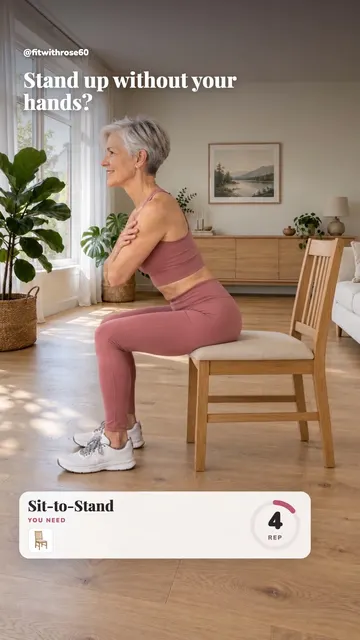
Sit-to-Stand (short video)
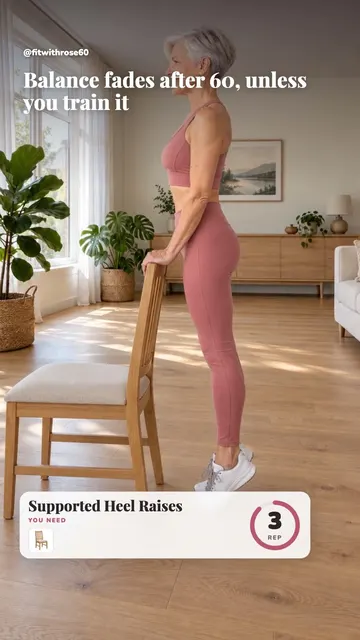
Supported Heel Raises (short video)

Get the free PDF guide
Strong & Steady: The Chair, Band & Mat Starter Guide. 9 pages to print or keep on your phone:
- 12 moves with pictures and simple steps;
- two sessions of about 20 minutes;
- a weekly plan with boxes to tick, and a plan for your first four weeks.
Questions
What are good balance exercises for seniors?
Simple, supported moves are a good start: standing up from a chair, heel raises, standing on one foot, side steps and the heel-to-toe walk. The CDC and the National Institute on Aging both list several of these as examples of balance exercises for older adults.
How often should seniors do balance exercises?
The National Institute on Aging suggests about three sessions of balance exercises a week. The WHO 2020 guidelines recommend activity that emphasizes balance and strength on 3 or more days a week for older adults.
Can balance exercises be done sitting down?
Some can be started seated: heel lifts, knee lifts and standing up from a chair all begin in a chair. They are a gentle way to begin. Move on to the standing versions, with a chair to hold, when you feel ready.
Do balance exercises reduce falls?
In a 2019 Cochrane review of 108 trials with older people living in the community, exercise reduced the rate of falls by 23%, and balance and functional exercises by 24%. These are average results from studies, not a promise: talk to your doctor about your own risk, especially if you have fallen.
What should I hold on to during balance exercises?
A sturdy chair without wheels placed against a wall, or a kitchen counter. The National Institute on Aging advises having a sturdy chair, a person or a wall nearby to hold onto for support.
Keep going
Strength training for women over 60: a simple weekly plan
How much strength training the CDC and WHO recommend, a sample week, and seven home moves for every major muscle group, with seated or standing options.
Resistance band exercises for seniors: 7 gentle moves
Seven band moves with pictures, seated and standing options, sets and reps, and what the research says about training with bands.
Chair exercises for seniors: free printable guide
9 chair exercises with pictures, steps and reps to print, plus the free PDF guide with a weekly plan.
Sources
Health facts in this article come from these sources, checked on 25 October 2026. Studies were read on PubMed. The moves, steps and repetitions come from the Fit with Rose guide.
- CDC, Older Adult Activity: An Overview, page dated 4 December 2025.
- CDC, Facts About Older Adult Falls, page updated 4 September 2026.
- National Institute on Aging (NIH), Three Types of Exercise Can Improve Your Health and Physical Ability, content reviewed 14 January 2025.
- Bull FC, et al. (World Health Organization), British Journal of Sports Medicine, World Health Organization 2020 guidelines on physical activity and sedentary behaviour, 2020.
- Sherrington C, et al., Cochrane Database of Systematic Reviews, Exercise for preventing falls in older people living in the community, 2019.
- NHS, Physical activity guidelines for older adults, page last reviewed 15 August 2024.
Rose is an AI-generated character, not a real person, and not a doctor, physical therapist or certified trainer. This article shares general fitness information, not medical advice.